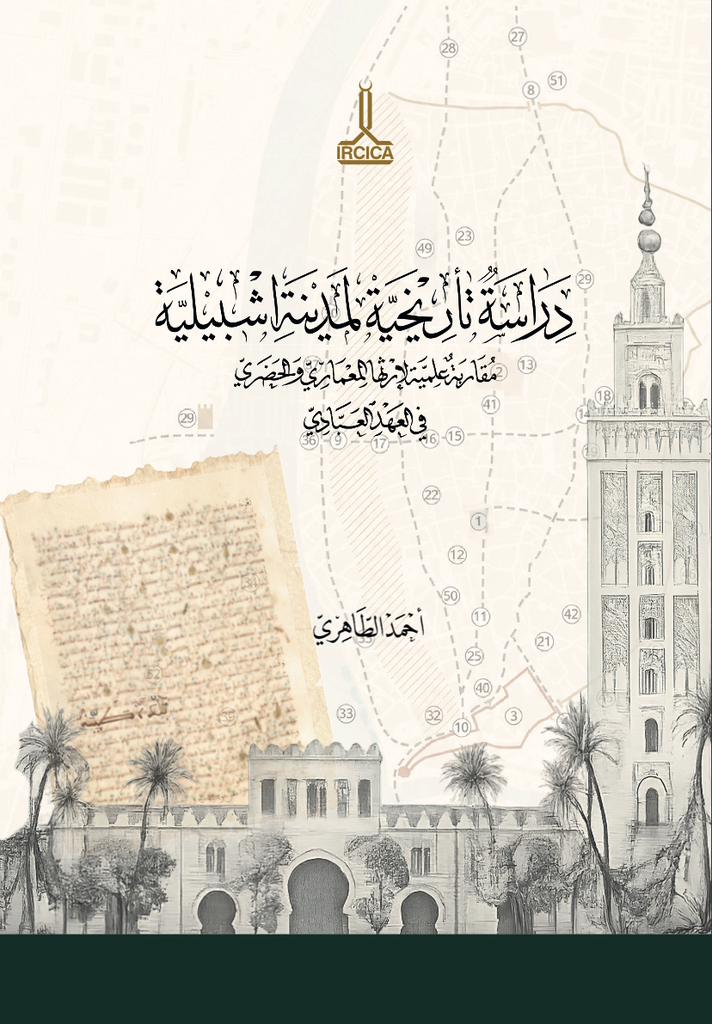
The Historiographical Study of the City of Seville. A Scientific Approach to its Architectural and Urban Legacy during the Abbādid Era
أحمد الطاهري
دراسة تاريخية لمدينة إشبيلية: مقارنة علمية لدارها المعماري والحضري في العهد العبادي
IRCICA, Istanbul, 2026
Preface: Prof. Dr. Mahmud Erol Kılıç
Editors: Attallah Alrawashdeh & Alidost Ertuğrul
In Arabic, 268 p.
ISBN 978-92-9063-487-4
IRCICA has the pleasure to present Professor Ahmed Tahiri’s historiographical study on the city of Seville, which was one of the most important cities of Spain during the Islamic period in Andalusia. The book was originally published in Spanish in 2025; its English and Arabic versions rendered by the author himself have been published by IRCICA in 2026. A scholar of medieval history, Al-Andalus and the Maghreb, and currently President of the Idrisi Hispano-Moroccan Foundation for Historical, Archaeological, and Architectural Research (Tetouan, Morocco; Sevilla, Spain), Professor Ahmed Tahiri dedicated years of research to the history of Andalusia and the Maghreb, pioneering new insights and findings in these fields of study. This book is a prime example of his contribution to the field. The Abbādid dynasty –Banū Abbād was a Muslim-Arab dynasty in Andalusia that arose in Seville in the 11th century, in the period of the ṭāʾifahs (faction kingdoms) following the downfall of the Córdoba Caliphate. Though relatively short (1023-1091), this period was marked by significant developments in sciences and technology, arts and architecture, literature, and a climate of learning and scholarly pursuit, with the ensuing openness to multi-faith and multicultural coexistence, thus typifying the praiseworthy achievements of the period of Muslim rule in Andalusia described by historians. Professor Tahiri’s book explores Sevilla during that period, through an almost real journey across the evolution of its urban expansion and architectural structures. From hundreds of manuscript sources, narratives and other primary materials, many of them fragmented, dispersed, and previously untapped, the author reconstructs the historical topography of the Abbādid city by delving deeper than the layer of alterations and relocations conducted later, under the succeeding Almoravid (up to 1146) and Almohad (1146-1248) rules. The author’s conclusions align with recent archaeological findings pointing to the need to reassess the geographical and temporal location of the historic core of Sevilla and thus, to give the long-overdue historical recognition to the true drivers and architects of its urban glory, the Abbādids. A fascinating reading also instructive for its method, the book published simultaneously in two languages will appeal to both researchers in the field and the general reader.